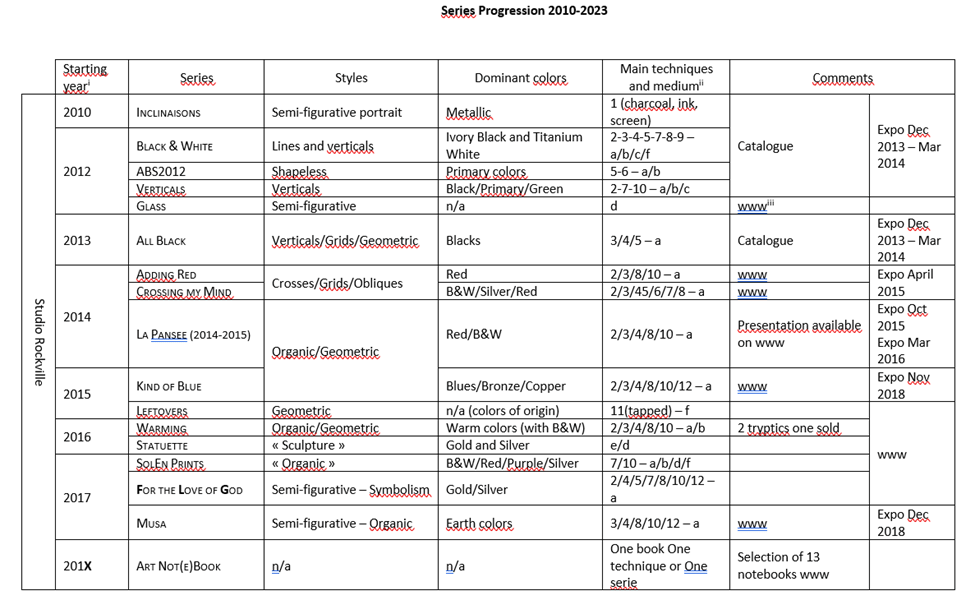
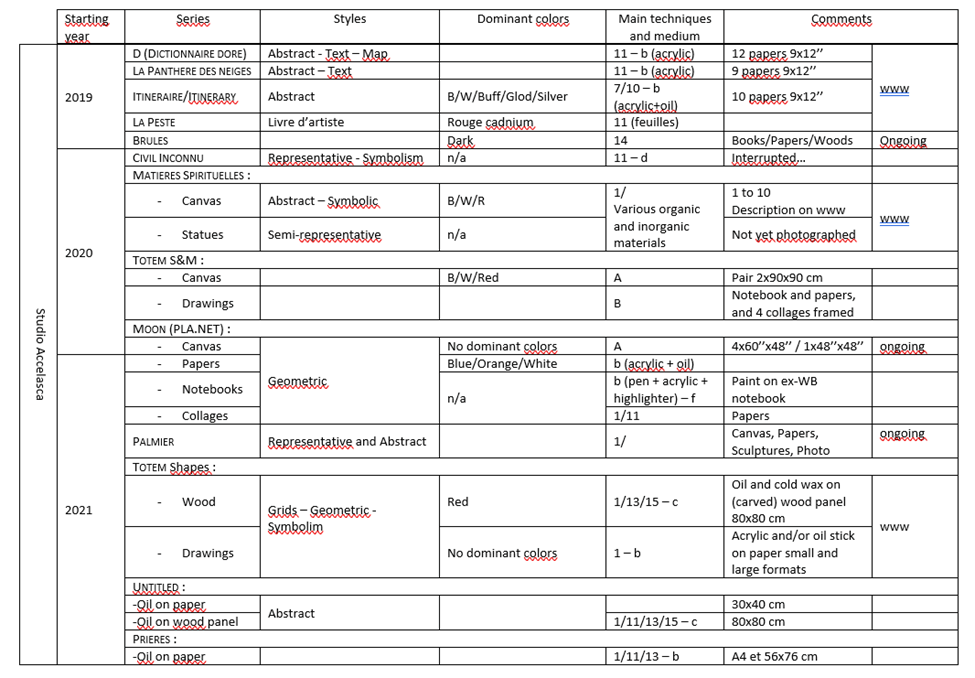
Series started in 2010 with Inclinaisons, an experiment of mixed-media semi-figurative portraits. Starting in 2012, each year saw the production of at least one new series. Most of them are open-ended: they could be complemented with other pieces for years following their initiation. La Pansée, 2015, is one notable exception of a series of 12 paintings forming a large piece. Each series has its specific style (mostly abstract with a small number of exceptions of semi-figurative imagery), color palette and set of techniques. They are usually produced on various media with a few exceptions. They are presented in the section ARTWORKS in reverse chronological order.
My primary pigments are acrylic and ink — and more recently oil (sometimes mixed with cold wax) —, used on various supports. I like to experiment with various media. My favorites remain canvas and paper. With series, I rarely work on a single support. Papers are used for preparatory work, in parallel to canvas work, or to complement a series. I have used photo-paper since the earliest series, in particular with ivory black acrylic and inks. I experimented carving and painting with a few wood panels. I always work on several notebooks at a time to tell a story on the various ways to put a mark on a support [Art NoteBooks]. Mixed-media has been specifically used to explore drawing-screen relationship [Inclinaisons]. With the series [Matieres spirituelles], I have worked with various materials. I am not a photographer and use photos to record visual notes that could be later used with paintings [Glass]. The use of bricks as a 3D support [staCHəˈwet] came by chance since they were originally used as a painting tool for monoprints. In the series [Leftovers], I have recycled masking tapes and rearranged them to create new compositions.
“Post-modernism stands for diversity and inclusion. Any and all artistic memes of the “isms” of the past century can be and are combined to create either a visual mish-mash in the worst case, or brilliant new imagery in the best. François Le Gall’s exquisite, elegant work falls, easily into the latter group.” Florie Gilbard, 2013.
- Interview (English and French), August 2015
- The Washington Post Jan 19 2014
- Florie Gilbard essay on artist Francois Le Gall 2013


 François Le Gall